E-Commerce Management System on Odoo
Our e-commerce management system connects your online store, catalog, orders, inventory, payments, shipping, customers and accounting in one Odoo system — so every order flows from checkout to delivery and invoice without re-keying.
For D2C brands, B2B wholesalers and retailers selling online and in store, including businesses with several storefronts or marketplaces.
What we set up
- Odoo online store or storefront integration
- Products, variants, pricelists and promotions
- Order processing and customer portal
- Live stock across warehouses and channels
- Payment providers and shipping carriers
- Sales, margin and inventory dashboards
Trusted by businesses in retail, textile, distribution, services and the public sector










What Goes Wrong When Your Online Store Runs Separately from Operations?
Most online sellers juggle a storefront, spreadsheets and separate accounting. These are the problems we’re asked to fix.
Overselling and stock mismatches
Website stock doesn’t match the warehouse or other channels.
Orders re-keyed by hand
Web orders are copied into the ERP or accounting tool.
Messy catalog and pricing
Products, variants and prices are maintained in several places.
Slow fulfilment
Picking, packing and labels are handled outside the system.
Payments not reconciled
Online payments are matched to orders and banks by hand.
No clear margins
Sales, costs and returns live in different reports.
What Is an E-Commerce Management System?
We deliver e-commerce management on Odoo, using its Website, eCommerce, Sales, Inventory and Accounting apps, or connecting your existing storefront to Odoo. See our Odoo customization and Odoo implementation services.
How Does Odoo Connect E-Commerce Operations?
Every channel and back-office team works from one database, so store, stock, shipping and accounts always agree.
E-Commerce Management System Modules
Configured and extended for your products, channels and fulfilment.
Online Store
- Odoo eCommerce website
- Mobile-friendly product pages
- Customer accounts and portal
Catalog & Pricing
- Products and variants
- Pricelists by customer or country
- Coupons, promotions and loyalty
Order Management
- Web orders in Odoo Sales
- Order status and notifications
- B2B quotes and reorders
Inventory & Warehouses
- Live stock by warehouse
- Reordering rules
- Multi-warehouse routing
Payments
- Online payment providers
- Payment status on orders
- Refunds and credit notes
Shipping & Fulfilment
- Pick, pack and ship
- Carrier rates and labels
- Tracking for customers
Customers & Marketing
- Customer history in CRM
- Email marketing
- Abandoned cart follow-up
Channel Integrations
- Marketplace connectors
- Existing storefront sync
- Point of sale for stores
How Does an Integrated E-Commerce Management System Work?
When your store, inventory, fulfilment and accounting share one Odoo database, a checkout reserves stock, creates the delivery and records the payment — and the invoice, margin and customer history update automatically.
- Web orders created in Odoo at checkout
- Stock reserved and updated across channels
- Delivery, carrier label and tracking from the order
- Payments and invoices posted to accounting
- Sales, margin and stock reports in real time
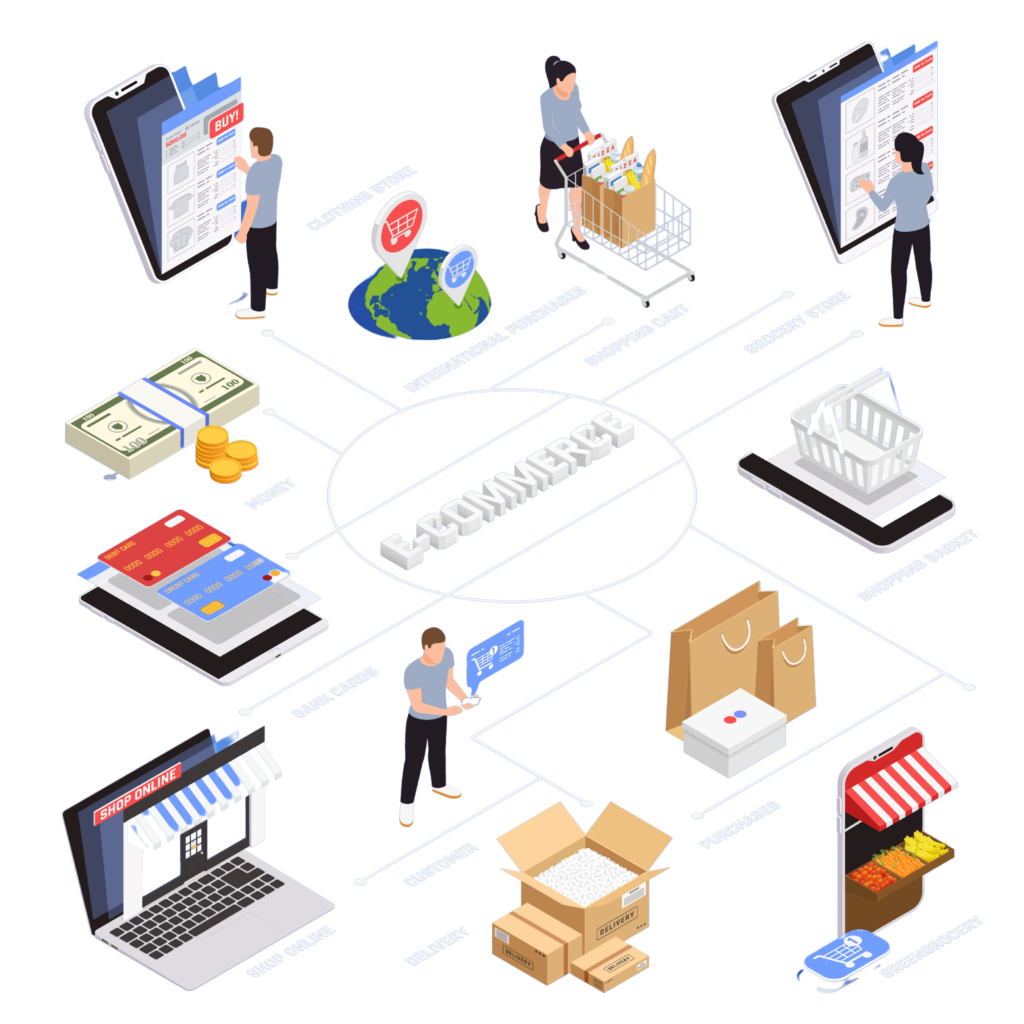
From Checkout to Delivery in an Odoo E-Commerce Management System
Each step updates the same order, so customers, warehouse and finance always see its current status.
Which Online Businesses Is It For?
We configure Odoo for the way you sell, fulfil and get paid.
How We Implement an E-Commerce Management System on Odoo
A structured rollout that keeps orders flowing.
Business Assessment
We map channels, catalog, fulfilment, payments and reporting.
Why it matters: The system fits how you sell.
You get: A process map and scope.
Solution Design
Store approach, catalog structure, pricing, warehouses and integrations defined.
Why it matters: No surprises during rollout.
You get: A solution blueprint.
Configuration & Development
Odoo configured, store designed and integrations built.
Why it matters: A system shaped around your channels.
You get: A test store.
Data Migration
Products, variants, customers, prices and open orders loaded.
Why it matters: Accurate catalog and stock from day one.
You get: Validated data.
Testing & Training
Checkout, payment, fulfilment and returns tested end to end.
Why it matters: Teams are confident at launch.
You get: Trained users.
Go-Live & Support
Launch, monitoring and ongoing improvements.
Why it matters: Orders keep flowing during the switch.
You get: A live, supported store.
Planning a store launch or relaunch?
We’ll set up catalog, payments and shipping before you go live.
Book a DemoStandalone Store vs Store Plus Plugins vs Odoo E-Commerce Management
What changes when your store and operations run on one platform.
Standalone storefront
- Orders exported by hand
- Stock updated manually
- Accounting done separately
- No view of margins
Storefront plus many plugins
- Several apps to connect
- Data out of sync
- Fees for each add-on
- Hard to trace an order end to end
Odoo e-commerce management
- Store, stock and accounts in one system
- Live inventory on every channel
- Fulfilment from the order
- Payments reconciled automatically
- Real-time sales and margin reports
The Odoo Apps Behind Your Online Business
Standard Odoo apps, extended with custom features and channel integrations.
Selling
Winning and serving customers.
Operations
Fulfilling every order.
Finance & insight
Getting paid and reporting.
Why Choose MP Technolabs for Your E-Commerce Management System?
An Odoo team that connects the storefront to the back office.
How Much Does an E-Commerce Management System Cost?
We estimate after understanding your channels. The main factors are:
| Factor | Why it matters |
|---|---|
| Store approach | Odoo store or existing storefront |
| Catalog size | Products, variants and prices |
| Channels | Web, marketplaces, stores |
| Integrations | Payments, carriers, marketplaces |
| Customization | Features beyond standard Odoo |
| Data migration | Products, customers, orders |
| Design | Theme and page design needs |
What Are the Benefits of an E-Commerce Management System?
A connected e-commerce system helps you:
- Stop overselling with live stock on every channel
- Process orders without re-keying
- Ship faster with labels and tracking from the order
- Reconcile online payments automatically
- Manage prices and promotions in one place
- See sales and margins in real time
Results depend on your starting point; we agree the KPIs to track during the assessment.
What Our Odoo Clients Say
Real words from real clients.
I’ve tried many partners, but I feel trust and experience with only the MP Technolabs team.
I appreciate working with the team — they delivered the project successfully.
I’ve never seen responsiveness like the MP Technolabs team provides — 24/7 support, they’re always there.
E-Commerce Management System FAQs
Clear answers to what online sellers ask before choosing a system.
What is an e-commerce management system?
An e-commerce management system runs the operations behind an online store — catalog and pricing, orders, inventory, payments, shipping, customers, returns and accounting — in one system.
Can Odoo run our online store?
Yes. Odoo Website and eCommerce provide the storefront, product pages, cart and checkout, connected directly to Sales, Inventory and Accounting.
Can we keep Shopify or WooCommerce and use Odoo behind it?
Yes. We can connect an existing storefront to Odoo so orders, stock, customers and payments sync with Odoo, depending on the platform’s API.
Can Odoo connect to marketplaces?
Yes. Odoo offers connectors for some marketplaces, and we build or configure integrations for others where they provide an API.
Does it sync stock across channels?
Yes. Odoo Inventory is the single stock source, so the website, marketplaces and stores sell from the same live quantities.
Does it support B2B e-commerce?
Yes. Customer-specific pricelists, portal ordering, quotations and payment terms support B2B buyers alongside B2C shoppers.
Which payment methods are supported?
Odoo integrates with a range of online payment providers. We confirm the providers available in your countries during the assessment.
Can it print shipping labels and track deliveries?
Yes. Odoo shipping connectors can calculate carrier rates, print labels and share tracking numbers for supported carriers.
Does it handle returns and refunds?
Yes. Returns can be recorded against the order, stock received back and refunds or credit notes issued in accounting.
Can we run several online stores?
Yes. Odoo supports multiple websites from one database, with shared or separate catalogs, pricing and branding.
Does it work with our physical stores?
Yes. Odoo Point of Sale shares products, customers and stock with the online store for a connected retail setup.
Can you migrate products and orders from our current platform?
Yes. We migrate products, variants, customers, prices and open orders, and validate them before launch.
Which Odoo versions do you work with?
We have worked with Odoo versions from V8 to V20, and implement or upgrade to the version that suits you.
How long does implementation take?
It depends on store approach, catalog, channels, integrations and data. You receive a timeline after the business assessment.
How much does an e-commerce management system cost?
It depends on store approach, catalog size, channels, integrations, customization, data and design. Request an estimate.
Ready to Connect Your Store and Operations?
Tell us about your store, channels and current systems. We’ll show you how Odoo can run selling, fulfilment and finance together.